Research Article | | Peer-Reviewed

Biological Wastewater Treatment Using Higher Aquatic Plants

Received: 28 June 2024     Accepted: 4 October 2024     Published: 13 November 2024
Views:       Downloads:
Abstract

This article presents the results of research on the biological treatment of various industrial and domestic wastewater using higher aquatic plants. The experiments examined the possibility of biological treatment of mining wastewater on a semi-industrial scale using Eichhornia crassipes Solms, Pistia stratiotes L. Azolla caroliniana and Lemna minor and their features in biological treatment are identified. Eichhornia and pistia plants are important because they show high efficiency in wastewater treatment due to their high adsorption properties, with frequent renewal of biomass in ponds, the phytoremediation capacity of higher aquatic plants is 51% per day due to the adsorption properties of plants, based on calculations, it is possible to propose cleaning pools with a volume of 1000 cubic meters of water for 5 days, through the renewal of plant culture every 1-3 days. The use of purification methods in this way recommends the construction of additional structures. In this case, depending on the volume of wastewater from the plant, it is necessary to build additional bioponds, create a water transfer system, and also build additional bioponds for the purpose of growing biomass or increasing plants. Only then can the biological purification method we recommend be used on an industrial scale or at an industrial enterprise to purify wastewater in an environmentally safe and cost-effective manner.

Published in Journal of Energy, Environmental & Chemical Engineering (Volume 9, Issue 4)
DOI 10.11648/j.jeece.20240904.11
Page(s) 94-99
Creative Commons

This is an Open Access article, distributed under the terms of the Creative Commons Attribution 4.0 International License (http://creativecommons.org/licenses/by/4.0/), which permits unrestricted use, distribution and reproduction in any medium or format, provided the original work is properly cited.

Copyright

Copyright © The Author(s), 2024. Published by Science Publishing Group

Keywords

Biological Treatment, Wastewater, Eichornia, Pistia, Azolla, Lemna, Heavy Metals

1. Introduction
Currently, great importance is attached to the prevention of water pollution. Wastewater from household and industrial enterprises is treated at separate facilities and discharged back into water bodies. As a result, water bodies are also polluted to a certain extent. In recent years, our government has adopted a number of documents aimed at improving the sanitary condition of water bodies.
It is known that the rapid development of industry and agricultural enterprises is one of the main factors in the pollution of water bodies with wastewater. When large amounts of wastewater are discharged into water bodies, maintaining their cleanliness is one of the important tasks of the national economy. Consequently, with the correct choice of wastewater treatment method, it is possible to achieve full compliance of wastewater discharged into water bodies with the requirements of sanitary standards.
Wastewater contains various types of pollutants. Organic pollutants create favorable conditions for the development of microorganisms. Therefore, one of the important factors in wastewater treatment is the separation and neutralization of impurities, especially organic substances.
All plants need biogenic elements, including a number of vital metals (Fe, Zn, Cu, Mn, Mo, Co) and are capable, to some degree or another, of extracting heavy metals from soils and aquatic environments. However, plants vary in their ability to extract metals from their environment and concentrate them in leaves and stems. Plants also differ significantly in their ability to accumulate and metabolize organic xenobiotics. The difference in the rate of absorption and transformation, the level of their accumulation ranges from several milligrams to several hundred milligrams per 1 kg of green mass per day. Plants that are able to accumulate pollutants in increased quantities and transform them are less sensitive to pollution .
When treated in modern installations, the efficiency of wastewater treatment can reach 98%.
The study of the process of urban wastewater treatment at modern facilities is carried out in a laboratory installation. During the experiment, wastewater mixed with wastewater from various city departments and enterprises is prepared in the module. Various types of impurities in urban wastewater are detected by purification using modern installations.
A full-scale membrane bioreactor (MBR) with ultrafiltration, followed by granular activated carbon (GAC), was examined to determine the potential of reusing treated water as a source of drinking water or for irrigation.
The determination of the necessary indicators of quality and percentage of water during the experiment is carried out in accordance with the relevant regulations based on the analysis methodology.
The purpose and objectives of the research are to develop a system for efficient water use in the city of Navoi and improve the process of treating domestic and industrial wastewater generated in the city.
To achieve this goal, it is necessary to solve the following issues (tasks):
a. study the types and composition of wastewater generated in the city;
b. study of urban wastewater discharge systems;
c. analysis of methods for treating urban wastewater;
d. study ways to treat wastewater containing various impurities;
e. creation of a mathematical model of the process of urban wastewater treatment;
f. conducting experimental studies on urban wastewater treatment and analyzing their results;
g. making proposals and recommendations for the efficient use of water in the city;
h. making proposals and comments to improve the process of urban wastewater treatment.
1. Research methods.
When analyzing the composition of wastewater and methods of its treatment, scientific and technical literature is studied and analyzed, as well as completed dissertations in this area.
The study of the wastewater treatment process at modern facilities is carried out in laboratory conditions using generally accepted analytical methods of analytical chemistry. The determination of the necessary quality indicators and their content during the experiment is carried out in accordance with the relevant regulations on the basis of the analysis methodology.
Among biological purification methods, two types are widely used today: using microorganisms and using higher aquatic plants. They are based on the ability of some living organisms to use pollutants and heavy metal ions in the process of their life.
Wastewater refers to any water that is contaminated by the domestic, commercial, and industrial use. Wastewater treatment plants (WWTPs) which are used for the decontamination and waste removal can be classified based on the type of wastewater that needs to be treated, i.e., agricultural, municipal, and industrial wastewater .
2. The Results Obtained and Their Discussion
The use of green plants for the purification of wastewater, soil and atmospheric air is called phytoremediation, and includes such subspecies as phytoextraction, consortium bioremediation, rhizofiltration, phytotransformation, phytostabilization, phytovolatilization, etc.
Aquatic plants, both in natural reservoirs and bioponds, perform the following functions:
a. filtration (promote sedimentation of suspended particles);
b. absorption (absorption of nutrients and some organic substances);
c. accumulative (the ability to accumulate certain metals and organic substances that are difficult to decompose);
d. oxidative (during the process of photosynthesis, water is enriched with oxygen);
e. detoxification (plants are able to accumulate toxic substances and convert them into non-toxic ones).
The ability of higher aquatic plants to remove pollutants from water - nutrients (nitrogen, phosphorus, potassium, calcium, magnesium, manganese, sulfur), heavy metals (cadmium, copper, lead, zinc, etc.), phenols, sulfates - and reduce its pollution petroleum products, synthetic surfactants, which is controlled by such indicators of organic environmental pollution as biological and chemical oxygen consumption, made it possible to use them in the practice of purifying industrial, household wastewater and surface runoff.
1.1. Purpose and Standards of Wastewater Treatment
Wastewater treatment plants are designed to employ distinct water treatment processes with different water treatment facilities depending on the influent characteristics and effluent discharge standards .
Wastewater treatment is carried out in order to remove suspended and soluble organic and inorganic compounds from them to concentrations that do not exceed regulated ones (maximum permissible concentrations, MAC). The lower the contaminant content in treated wastewater, the higher its quality. Quality standards and volumes of discharged water (maximum permissible discharges, MPD) are assigned taking into account the ratio of volumes of discharged wastewater and water of the receiving natural reservoir, self-purification processes in the reservoir, category of the reservoir and the content of background pollution. In the case of using river water for cultural, domestic or drinking purposes, the water quality indicators are regulated in the control sample, in which the composition and properties of the water must correspond to the normative ones and which is located at a distance of 1 km above the nearest point of water use or water consumption downstream.
In Uzbekistan, the requirements for the quality of treated wastewater are contained in the Law of the Republic of Uzbekistan “On Water and Water Use”, “Hygienic and Anti-epidemic Requirements for the Protection of Water in Reservoirs on the Territory of the Republic of Uzbekistan”, building codes and rules for the design of sewerage and treatment facilities. All these documents define the conditions for the disposal of wastewater into reservoirs, and their implementation is mandatory for both industrial facilities and business entities.
There is a distinction between water consumption and water use. When water is consumed, water is removed from its location and moved. The main consumers of water are industry, agriculture, mining, and domestic and drinking water supply. Environmental documents regulate the content of contaminants in drinking water.
When using water, water is used without removal from its localization sites. The largest water users are hydropower, transport, fisheries, and recreation. The content of pollutants in the water of reservoirs for cultural, domestic and fishing purposes is standardized.
In some cases, mechanical and chemical cleaning does not produce the required results. An alternative is thermal disposal of process wastewater by burning it in furnaces, burners and various types of installations. Thermal decomposition furnaces (more advanced, but expensive) are the most widely used abroad. In Russia, the fire method is widely used - universal, reliable and inexpensive. Its essence lies in the fact that process wastewater in a finely dispersed state is injected into a torch formed by burning gaseous or liquid fuel. In this case, water evaporates, and harmful impurities decompose (burn) into components (CO2 and H2O).
1.2. Consumption of Water Resources by NMMC
One common process in wastewater treatment is phase separation, such as sedimentation. Biological and chemical processes such as oxidation are another example. Polishing is also an example. The main by-product from wastewater treatment plants is a type of sludge that is usually treated in the same or another wastewater treatment plant .
NMMC divisions are located in regions with high (40–80%), extremely high (more than 80%) water deficit and in arid, low-water areas. In order to carry out water intake from underground sources, the company issues a permit for special water use and is approved by the State Committee for Geology and the State Committee for Ecology for intake from surface sources. The plant has received a permit for special water consumption from the State Committee for Nature Protection for all divisions of NMMC that are water consumers from natural sources of surface and ground water.
NMMC carries out water intake from the Amudarya and Zerafshan rivers, the Tusunsay reservoir and artesian water intake wells . The consumed water is intended to satisfy the production and domestic needs of the enterprise.
In the initial series of experiments, the influence of wastewater from the Koch-Bulak treatment plant of the Angren Mining Department of the Almalyk Mining and Metallurgical Combine (AMMC) on the growth of aquatic plants was studied .
Navoi Mine Metallurgical Combine (NMMC) consumes water in regions with water shortages. As shown in Diagram 1, the total water intake in 2019 amounted to 121.3 million m³, which is 3% more than in 2018. The total amount of wastewater in the company in the reporting year amounted to 12.3 million m³ .
2. Result
Wastewater treatment is a process which removes and eliminates contaminants from wastewater. It thus converts it into an effluent that can be returned to the water cycle. Once back in the water cycle, the effluent creates an acceptable impact on the environment. It is also possible to reuse it. This process is called water reclamation.
An artificial pond was created at the Navoi State Pedagogical Institute and plants were massively propagated on an artificial nutrient medium for a month.
Experiments conducted with the help of aquatic plants for the purpose of treating tailings wastewater were carried out in several versions:
a. by adsorption of heavy metals by the biomass of aquatic plants;
b. by introducing an organo-mineral nutrient medium (active sludge-dry mass) in order to accelerate the growth and development of aquatic plants in wastewater;
c. through the integrated use of activated sludge and adsorbent;
d. by direct planting of aquatic plants into wastewater without any additives.
The experiments were carried out at the wastewater treatment plant (WWTP) of the city of Uchkuduk. For wastewater treatment, plant biomass grown in NavSPI bioponds was used. Based on the production requirements of wastewater treatment processes, experiments were carried out based on the results obtained in the shortest possible time. Because the faster wastewater is treated and returned to the production process for reuse, the higher the economic efficiency. Therefore, the experiments conducted at the Uchkuduk WWTP were continued for a week.
On July 26, 2022, in the city of Uchkuduk, a system of artificial multi-stage ponds was prepared in which plants were planted. As a nutrient medium for plants, samples of dry activated sludge from the activated sludge site of a WWTP (wastewater treatment plant) were added at a concentration of 10 g/l.
160 liters of water were brought from the wastewater of MMP-3 and experiments were carried out in 8 different variants in two repetitions for single-stage wastewater treatment.
The experiments were carried out in 12-liter plastic containers (basins) with 10 liters of waste water. For this type of one-step cleaning, different options are possible, i.e. only Eichornia biomass, sawdust from dry Eichornia biomass as an adsorbent for the accumulation of heavy metals in wastewater and a nutrient medium to support the growth and development of Eichornia under stress conditions. The dry mass of activated sludge obtained from the sludge site was added as an organic nutrient medium.
Oxidation reduces the biochemical oxygen demand of wastewater, and may reduce the toxicity of some impurities. Secondary treatment converts organic compounds into carbon dioxide, water and biosolids through oxidation and reduction reactions Chemical oxidation is widely used for disinfection.
The concentration of individual substances in the control variant, where there were no plants, increased due to water evaporation. Because in the control variant no foreign reagents were introduced into the wastewater. Therefore, the main comparative calculations of the options will be carried out in relation to the control option. According to the results of the experiments, if in the control version the initial concentration of dry residue in the wastewater was 5370 mg/l, then after the experiment this amount was 3040 mg/l in the experimental version. A decrease in the concentration of substances in the variants relative to the control variant is observed in almost all variants, and for most salts.
3. Discussion
Experiments have shown that biological wastewater treatment processes are not very effective when carried out in small volumes. In the experiment variants carried out above, the wastewater in the containers practically dried out within a week. This leads to a multiple increase in the concentration of wastewater, which is proven by the difference in the concentrations of substances when compared to the experimental and control variants. If experiments are carried out on an industrial scale, then we can expect wastewater treatment without unnecessary loss of water.
It should be noted that even in such extreme environmental conditions for plants, the plants did not lose their viability. This proves the possibility of adaptation and the role of the studied aquatic plants in biological treatment, which was also observed in the results of experiments in the laboratories of the Central Research Laboratory of NMMC.
In order to simulate the conditions of the natural environment of the tailings dumps MMF-3 (Mining metallurgical factory) and MMF-2 NMMC, experiments on wastewater treatment using higher aquatic plants were carried out on an artificially created open area (field conditions). However, the volume of wastewater stored in containers in the open air was intensively reduced due to high air temperatures and winds.
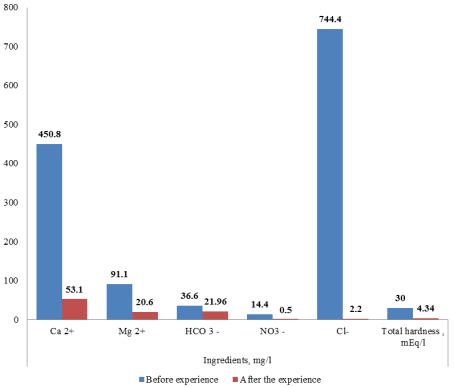
In this regard, some indicators of the effectiveness of biological treatment for 1 day are presented in the table below and clearly visible in diagram 1.
Table 1. Efficiency indicators of 1-day biological treatment.

Variant of experiments

Ingredients

Ca2+

Mg2+

HCO3-

NO3-

Cl-

Total hardness, mEq/l

Before experience

450.8

91.1

36.6

14.4

744.4

30.0

After the experience

53.1

20.6

21.96

0.5

2.2

4.34

Figure 1. Efficiency indicators for 1-day biological treatment (the number of ions is indicated in mg/l).
The following results were obtained in terms of efficiency indicators (number of ions in mg/l) for 1-day biological treatment. In this case, Ca2+ in water ranges from 450.8 to 53.1, Mg 2+ from 91.1 to 20.6, HCO3- from 36.6 to 21.96, NO3- from 14.4 to 0.5, CL- we can see that the ions have decreased from 744 to 2.2. and we can find that the total ions have decreased from 30 to 4.34.
4. Conclusions
Wastewater treatment is a set of measures to remove contaminants contained in domestic and industrial wastewater before discharging it into water bodies. Wastewater treatment is carried out at special treatment facilities .
The term "wastewater treatment" is often used to mean "sewage treatment" .
Thus, a study was conducted to test higher aquatic plants - azolla (A. caroliniana), pistia (P. stratiotes), eichornia (E. crassipes) and duckweed (L. minor) showed that they reduce the content of heavy metals in wastewater.
Based on the results of the experiments, we can conclude that the plant is an aquatic hyacinth can be used to purify water for various purposes from heavy metals and other wastewater contaminants. At this in the vegetative mass of eichornia grown on a contaminated substrate in within 10 days, there is no significant accumulation of these elements, despite the fact that the concentration in water decreases by 4–8 times.
Azolla biomass revealed its potential for accumulation of tested pollutants. A linear positive relationship was observed between the doses of each metal and its concentration in the biomass (R2>0.9). Cr (III) accumulated at much higher levels (up to 964 mg/kg wet weight) than Cr (VI) (up to 356 mg/kg body weight). Cd accumulated in very small quantities (up to 259 mg/kg wet weight), while Pb - up to 416 mg/kg body weight and Hg - up to 578 mg/kg body weight. These data confirm that Cr (VI), Cd and Hg are toxic heavy metals. However, their accumulation and survival of A. caroliniana suggest that this plant is capable of removing them in selected doses from wastewater.
The data obtained indicate that Pistia teloresidae adapts well to water bodies contaminated with copper and nickel. Moreover, the use of plants for phytoremediation is effective at concentrations of copper ions from 0.125 mg, zinc ions from 4 mg and nickel ions from 5 mg per 1 g of plant weight and below. In the case of nickel, it is worth considering the specific effects of this heavy metal on the plant.
Plants of Pistia teloresum and Duckweed intensively accumulate heavy metals from the aquatic environment.
Most industries produce some wastewater. Recent trends have been to minimize such production or to recycle treated wastewater within the production process. Some industries have been successful at redesigning their manufacturing processes to reduce or eliminate pollutants. .
Thus, based on the data obtained, a positive conclusion can be made about the possibility of using Pistia teloresis and Lemna minor for phytoremediation of the aquatic environment from various mineralization and ions of copper, zinc and nickel. In general, the results obtained indicate the possibility of using the studied higher aquatic plants in biological wastewater treatment.
Abbreviations

MPD

Maximum Permissible Discharges

AMMC

Almalyk Mining and Metallurgical Combine

NMMC

Navoi Mine Metallurgical Combine

WWTP

Wastewater Treatment Plant

MMF-3

Mining Metallurgical Factory

Conflicts of Interest
The authors declare no conflicts of interest.
References
[1] Kuznetsov A. E. et al. Applied ecobiotechnology: textbook: in volumes. T. 2 / - 3rd ed. - 492 s. - M.: BINOM. Laboratory of knowledge, 2015.
[2] Timofeeva S. S._ Drozdova I. V. Khuzhiev S. O. et al. Promising technologies for bioremediation of wastewater from gold mining enterprises in Uzbekistan. XXI CENTURY. TECHNOSPHERE SECURITY. 2022; 7(4): - P. 322–333.
[3] Kh. S. Turdaliyeva, SA Huzhzhiev and KS Safarov - Use of Aquatic Plants in Mine Wastewater Purification.- Current Journal of Applied Science and Technology// 36(5): - R. 1-7, 2019; Article no. CJAST.48874.
[4] Ponkratova O. I. On the path to prosperity. Report on the sustainable development of the State Enterprise "NMMC" for 2019.
[5] Assessing the potential of a membrane bioreactor and granular activated carbon process for wastewater reuse – A full-scale WWTP operated over one year in Scania, Sweden.
[6] Wastewater Treatment Plants are facilities where municipal and industrial wastewaters are processed to eliminate as much pollution as possible. Recent Advances in Multidisciplinary Applied Physics, 2005.
[7] Occurrence and fate of microplastics in urban water management systems. Huase Ou,... Eddy Y. Zeng, in Microplastic Contamination in Aquatic Environments (Second Edition), 2024. WWTP effluent is a significant source of phosphate to many different aquatic systems. From: Treatise on Geochemistry (Second Edition), 2014.
[8] Wastewater // Great Soviet Encyclopedia: [in 30 volumes] / ed.-in-chief A. M. Prokhorov.
[9] Sozonov N. A., Beloborodov A. V., Tenkovsky D. V. Horizontal flare units of TyumenNIIgiprogaz LLC // Expositsiya Neft Gas: magazine. - 2012. - No. 4. - P. 32-33. - ISSN 2076-6785. Archived June 16, 2013.
[10] Wastewater treatment | Process, History, Importance, Systems, & Technologies". Encyclopedia Britannica. October 29, 2020. Retrieved 2020-11-04.
[11] Metcalf & Eddy Wastewater Engineering: Treatment and Reuse (4th ed.). New York: McGraw-Hill. 2003. ISBN 0-07-112250-8.
[12] Tchobanoglous, George; Burton, Franklin L.; Stensel, H. David (2003). Metcalf & Eddy Wastewater Engineering: Treatment and Reuse (4th ed.). McGraw-Hill. ISBN 978-0-07-112250-4.
[13] Pollution Prevention Case Studies". Washington, D.C.: U.S. Environmental Protection Agency (EPA). 2021-08-11.
[14] BERGENDAHL, JOHN. "Applications of Advanced Oxidation for Wastewater Treatment" (PDF). Dept. Of Civil & Environmental Engineering, WPI. Archived (PDF) from the original on 2017-08-29.
[15] "Water Disinfection - an overview | ScienceDirect Topics".
Cite This Article
  • APA Style

    Khuzhzhiev, S. O., Bakhramov, I. Z., Gafurova, D., Khamraeva, M. D. (2024). Biological Wastewater Treatment Using Higher Aquatic Plants. Journal of Energy, Environmental & Chemical Engineering, 9(4), 94-99. https://doi.org/10.11648/j.jeece.20240904.11

    Copy | Download

    ACS Style

    Khuzhzhiev, S. O.; Bakhramov, I. Z.; Gafurova, D.; Khamraeva, M. D. Biological Wastewater Treatment Using Higher Aquatic Plants. J. Energy Environ. Chem. Eng. 2024, 9(4), 94-99. doi: 10.11648/j.jeece.20240904.11

    Copy | Download

    AMA Style

    Khuzhzhiev SO, Bakhramov IZ, Gafurova D, Khamraeva MD. Biological Wastewater Treatment Using Higher Aquatic Plants. J Energy Environ Chem Eng. 2024;9(4):94-99. doi: 10.11648/j.jeece.20240904.11

    Copy | Download

  • @article{10.11648/j.jeece.20240904.11,
      author = {Sodik Oltievich Khuzhzhiev and Inom Zakirovich Bakhramov and Dildora Gafurova and Madina Dadajonovna Khamraeva},
      title = {Biological Wastewater Treatment Using Higher Aquatic Plants
    },
      journal = {Journal of Energy, Environmental & Chemical Engineering},
      volume = {9},
      number = {4},
      pages = {94-99},
      doi = {10.11648/j.jeece.20240904.11},
      url = {https://doi.org/10.11648/j.jeece.20240904.11},
      eprint = {https://article.sciencepublishinggroup.com/pdf/10.11648.j.jeece.20240904.11},
      abstract = {This article presents the results of research on the biological treatment of various industrial and domestic wastewater using higher aquatic plants. The experiments examined the possibility of biological treatment of mining wastewater on a semi-industrial scale using Eichhornia crassipes Solms, Pistia stratiotes L. Azolla caroliniana and Lemna minor and their features in biological treatment are identified. Eichhornia and pistia plants are important because they show high efficiency in wastewater treatment due to their high adsorption properties, with frequent renewal of biomass in ponds, the phytoremediation capacity of higher aquatic plants is 51% per day due to the adsorption properties of plants, based on calculations, it is possible to propose cleaning pools with a volume of 1000 cubic meters of water for 5 days, through the renewal of plant culture every 1-3 days. The use of purification methods in this way recommends the construction of additional structures. In this case, depending on the volume of wastewater from the plant, it is necessary to build additional bioponds, create a water transfer system, and also build additional bioponds for the purpose of growing biomass or increasing plants. Only then can the biological purification method we recommend be used on an industrial scale or at an industrial enterprise to purify wastewater in an environmentally safe and cost-effective manner.
    },
     year = {2024}
    }
    

    Copy | Download

  • TY  - JOUR
    T1  - Biological Wastewater Treatment Using Higher Aquatic Plants
    
    AU  - Sodik Oltievich Khuzhzhiev
    AU  - Inom Zakirovich Bakhramov
    AU  - Dildora Gafurova
    AU  - Madina Dadajonovna Khamraeva
    Y1  - 2024/11/13
    PY  - 2024
    N1  - https://doi.org/10.11648/j.jeece.20240904.11
    DO  - 10.11648/j.jeece.20240904.11
    T2  - Journal of Energy, Environmental & Chemical Engineering
    JF  - Journal of Energy, Environmental & Chemical Engineering
    JO  - Journal of Energy, Environmental & Chemical Engineering
    SP  - 94
    EP  - 99
    PB  - Science Publishing Group
    SN  - 2637-434X
    UR  - https://doi.org/10.11648/j.jeece.20240904.11
    AB  - This article presents the results of research on the biological treatment of various industrial and domestic wastewater using higher aquatic plants. The experiments examined the possibility of biological treatment of mining wastewater on a semi-industrial scale using Eichhornia crassipes Solms, Pistia stratiotes L. Azolla caroliniana and Lemna minor and their features in biological treatment are identified. Eichhornia and pistia plants are important because they show high efficiency in wastewater treatment due to their high adsorption properties, with frequent renewal of biomass in ponds, the phytoremediation capacity of higher aquatic plants is 51% per day due to the adsorption properties of plants, based on calculations, it is possible to propose cleaning pools with a volume of 1000 cubic meters of water for 5 days, through the renewal of plant culture every 1-3 days. The use of purification methods in this way recommends the construction of additional structures. In this case, depending on the volume of wastewater from the plant, it is necessary to build additional bioponds, create a water transfer system, and also build additional bioponds for the purpose of growing biomass or increasing plants. Only then can the biological purification method we recommend be used on an industrial scale or at an industrial enterprise to purify wastewater in an environmentally safe and cost-effective manner.
    
    VL  - 9
    IS  - 4
    ER  - 

    Copy | Download

Author Information
  • Department of Biology, Navoi State Pedagogical Institute, Navoi City, Uzbekistan

  • Department of Biology, Navoi State Pedagogical Institute, Navoi City, Uzbekistan

  • Department of Biology, Navoi State Pedagogical Institute, Navoi City, Uzbekistan

  • Department of Biology, Navoi State Pedagogical Institute, Navoi City, Uzbekistan